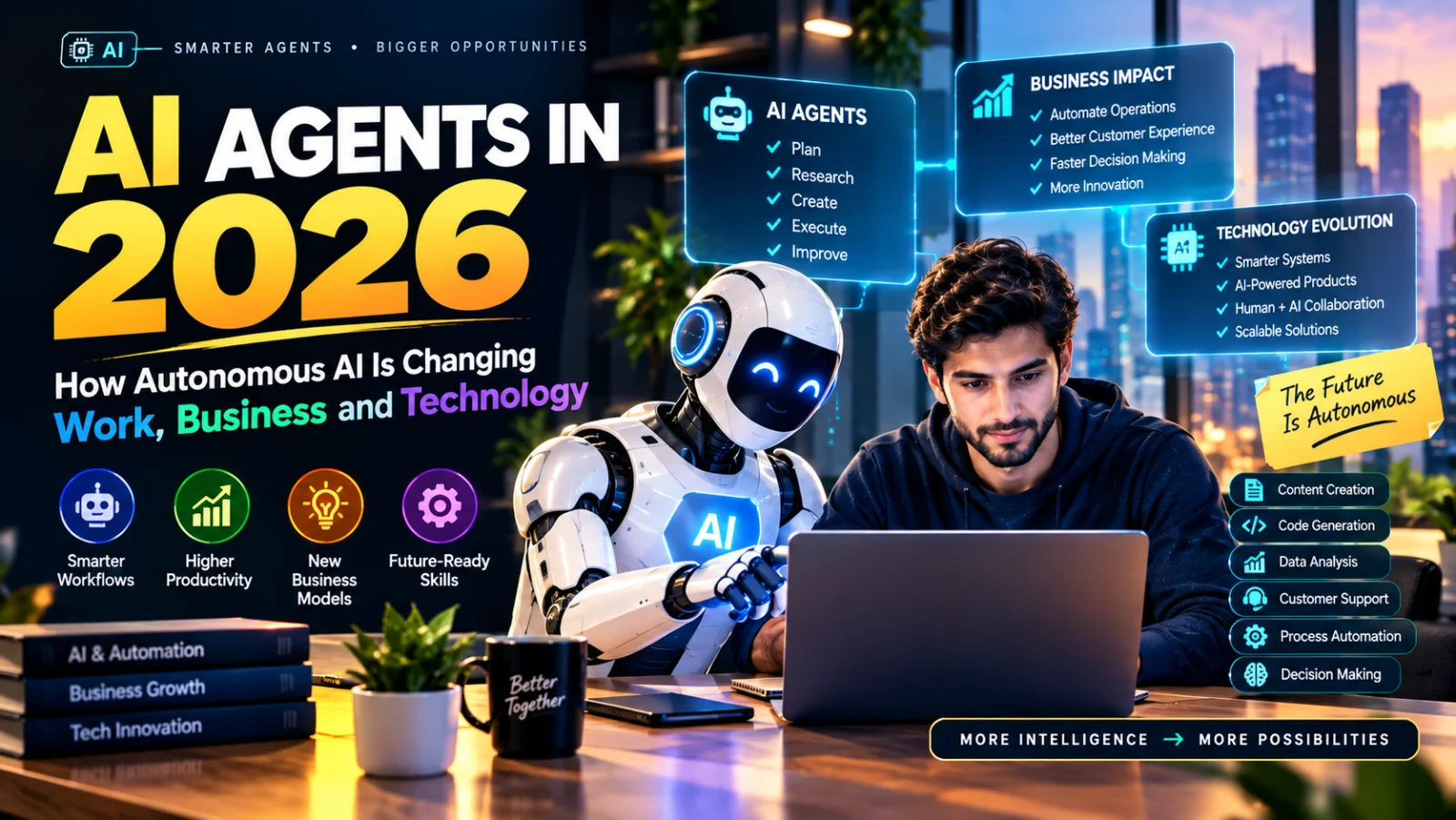

Over forty percent of global business data tasks are expected to run without direct human intervention by late 2026. Companies are moving away from simple prompt tools and adopting automated software that acts on its own. This shift makes AI agents in 2026 a major topic for business leaders and tech workers alike. Autonomous systems do not just talk to you; they complete actual work across multiple computer programs.
These tools represent a fundamental change in how software operates. Instead of waiting for human instructions at every stage, intelligent software agents organize their own steps to complete big projects. Businesses that adopt these tools gain a major speed advantage over their competition. Understanding how autonomous software works will help you protect your career and grow your business.
What Are Autonomous AI Agents and How Do They Work?
Autonomous AI agents are software programs designed to accomplish specific goals without needing step by step human guidance. You give the agent an objective, such as researching a competitor or reconciling a set of invoices. The agent then creates a plan, breaks the goal into smaller tasks, and chooses which tools to use. It executes each action, checks its own work, and fixes mistakes as it moves along.
Traditional software only follows fixed rules that a human coder wrote in advance. Older automation tools break the moment a website changes a button location or a file format shifts slightly. In contrast, autonomous agents use modern reasoning models to figure out alternative solutions when problems arise. They can browse the web, write computer code, update spreadsheets, and send emails to finish a project.
The engine behind an agent combines memory, planning ability, and tool access. Short term memory lets the agent track what it just did two minutes ago. Long term memory allows it to recall company policies and past project records. Tool integrations grant the agent permission to click buttons, download documents, and query company databases safely.
How AI Agents Differ From Standard Chatbots
Most people are familiar with standard chatbots that generate text answers when you ask a question. A chatbot waits for your prompt, produces a response, and then stops working completely. If you want a chatbot to help you write five different reports, you must type five separate prompts and copy the text manually. It remains a passive assistant that relies entirely on human effort to move projects forward.
Autonomous AI agents function as active digital coworkers rather than simple chat windows. An agent does not wait for you to guide every micro action. When assigned a project, it creates its own internal prompts and executes dozens of steps automatically. It can read a customer complaint, check inventory records, process a refund, and notify the warehouse manager without human delay.
This shift from conversational tools to action tools changes how productivity is measured. Workers no longer spend hours moving information between different web browser tabs. Instead, employees supervise teams of digital agents that complete the busywork in the background. Your job changes from doing every task by hand to managing digital workers who execute the work for you.
Real Ways AI Agents Save Time in Daily Work
Repetitive computer tasks consume hours of valuable employee time every single week. Office workers spend huge portions of their day organizing email inboxes, scheduling meetings, and copying data between spreadsheets. AI agents in 2026 handle these routine activities quietly in the background. This frees up human energy for creative projects, client relationships, and strategic planning.
Managing email communication becomes much simpler with autonomous tools. An agent can scan hundreds of incoming messages, identify urgent requests, and draft accurate replies based on company files. It can also follow up with clients who have not answered your previous notes. Important messages get flagged for your personal attention, while routine inquiries get solved instantly.
Calendar management and meeting coordination also see massive improvements. Setting up a call between six busy executives across different time zones used to take days of back and forth messages. An autonomous agent talks directly to other agents, checks calendar availability, and reserves open meeting slots automatically. It prepares background briefs for every attendee before the meeting starts so everyone arrives ready to talk.
Information retrieval is another area where autonomous software delivers instant benefits. Finding a specific contract clause or sales figure across thousands of company files used to take hours. An agent reads all internal documents, extracts the exact facts you need, and builds a clean summary. You get clear answers in seconds instead of digging through messy folders.
How AI Agents in Business Drive Higher Profits
Businesses survive on profit margins, and automated systems directly lower operational overhead. When companies deploy AI agents in business operations, they resolve customer issues faster and eliminate expensive data errors. Labor costs for repetitive data entry drop significantly while output volume increases. Companies can expand their operations without needing to hire massive support departments.
Customer support departments benefit immediately from autonomous agents that work around the clock. Unlike standard automated phone menus that frustrate callers, modern agents resolve complex support tickets directly. An agent can verify identity, diagnose a service issue, update account permissions, and issue credits in seconds. Customers receive immediate help at two in the morning without waiting on hold.
Sales departments use intelligent agents to qualify leads and nurture potential buyers. The agent tracks customer activity on your website, identifies buying signals, and sends personalized follow up messages. It answers technical product questions and books sales demos for your human sales team. This continuous outreach keeps your sales pipeline full of qualified prospects day and night.
Supply chain management becomes much more reliable with automated oversight. Agents monitor inventory levels, track weather patterns that might delay shipments, and reorder parts before stock runs out. If a supplier fails to deliver on time, the agent finds alternative vendors and negotiates delivery dates. Preventing warehouse stockouts keeps customer orders moving and protects company revenue.
Key Industries Being Transformed by Autonomous Systems
The healthcare sector is using autonomous systems to reduce administrative burdens on doctors and nurses. Medical agents handle patient intake forms, verify insurance coverage, and schedule diagnostic scans. They organize clinical records and highlight critical lab values that require immediate physician review. Nurses spend less time typing on computers and more time caring for patients at the bedside.
Financial institutions use autonomous software to detect fraud and manage investment risk. Fraud detection agents analyze millions of bank card transactions every minute to spot suspicious spending patterns. Loan processing agents review tax forms, verify employment records, and calculate debt ratios in minutes instead of weeks. Faster loan approvals allow banks to serve more clients while keeping credit risk under control.
Software development teams rely heavily on coding agents to build and test new features. A software agent can write standard code functions, run automated security checks, and locate software bugs before launch. It can even propose fixes and update technical documentation automatically. Engineering teams ship reliable software products in days rather than waiting for long monthly release cycles.
Online retail stores use autonomous tools to optimize pricing and manage merchant catalogs. Product agents generate accurate item descriptions, update inventory tags, and adjust retail prices based on competitor actions. Marketing agents create customized ad campaigns for different customer groups and adjust spending based on ad performance. These continuous optimizations help store owners maximize their daily sales volume.
Logistics and transport companies deploy agents to optimize shipping routes and schedule fleet maintenance. Transport agents analyze live traffic reports, fuel prices, and delivery deadlines to choose the most efficient travel paths. Maintenance agents track sensor data from truck engines to schedule repairs before breakdowns happen on the highway. Keeping delivery vehicles on the road saves millions of dollars in vehicle repair and fuel costs.
Comparing Software Automation Tools
Understanding the differences between software tools helps you choose the right system for your company needs. The table below outlines how traditional software, basic chatbots, and autonomous agents compare across critical daily functions.
| Feature | Traditional Software | Standard Chatbots | Autonomous AI Agents |
|---|---|---|---|
| Task Execution | Follows rigid manual rules | Produces text on request | Creates and executes multi step plans |
| Human Oversight | Requires human input for each step | Requires a prompt for each answer | Works toward a goal with minimal input |
| Tool Usage | Limited to its own program | Usually cannot use outside apps | Browses web, runs code, and edits files |
| Error Recovery | Crashes or stops when blocked | Asks user for another prompt | Tries new methods to fix its own errors |
How Multi Agent Systems Collaborate
One major trend in autonomous systems 2026 is the rise of multi agent collaboration. Instead of relying on a single giant software program to do everything, businesses deploy teams of specialized agents. Each agent in the system has a distinct role, specific tools, and clear performance goals. They talk to each other, delegate tasks, and review each other's work just like a human department.
Consider a market research project as a practical example of this collaborative workflow. A coordinator agent receives the initial business objective from a manager and creates a project plan. It commands a research agent to search the web for industry data and customer reviews. Once the data is gathered, an analyst agent runs financial calculations and identifies emerging market trends.
A writer agent then takes those analytical findings and drafts a comprehensive executive report. Next, an editor agent reviews the draft to check facts, improve clarity, and verify that numbers match the raw research. If the editor finds a factual error, it sends the report back to the writer agent for immediate corrections. The human manager receives a polished, verified report without ever doing the manual research.
This division of labor makes automated systems much more accurate and reliable. Small, focused agents make fewer mistakes than a single massive program trying to handle every task at once. If one agent encounters a technical failure, other agents can take over the task or notify a human supervisor. Multi agent workflows allow companies to automate complex business operations that once required large teams.
Real Challenges and Risks You Need to Manage
While autonomous software offers huge benefits, it also introduces real operational risks that companies must address. Software hallucinations remain a concern when models generate false information with high confidence. If an agent acts on incorrect data without human checks, it can make bad financial decisions or send flawed communications. Businesses must maintain sensible guardrails to keep automated actions safe.
Security vulnerabilities can expose sensitive corporate files if permissions are not set properly. An agent with unrestricted database access might share private customer information by mistake. Companies must apply strict security protocols and limit what actions an agent is allowed to execute on its own. Giving an agent access to company credit cards or administrative passwords requires multiple verification steps.
Infinite loops represent another practical technical challenge for automated workflows. An agent might get stuck trying to solve an impossible task, repeating the same actions over and over. This wasteful activity burns through expensive computing power without producing any useful outcome. Developers must program clear timeout limits and failure alerts to stop runaway agent processes.
Ethical concerns and job shifts require thoughtful leadership from business owners. While automation creates new high tech positions, it displaces workers who perform routine computer tasks. Companies that invest in autonomous systems must also invest in retraining programs for their staff. Helping employees transition into supervisory roles protects worker livelihoods and keeps company morale strong.
Essential Human Skills for Managing AI Agents
As autonomous software handles routine production tasks, human workers must develop supervisory skills. Formal computer engineering degrees are not necessary to succeed in this changing job market. You do need to know how to define clear goals, evaluate software outputs, and structure effective workflows. Workers who know how to manage digital agents will become the most valuable employees in their companies.
Goal definition is the most critical skill for directing autonomous systems. If you give an agent a vague instruction, you will receive poor results that waste time. You must learn to set precise project boundaries, define success metrics, and specify required file formats. Clear instructions allow the agent to build an accurate plan from the very start.
Critical thinking and fact checking protect your business from costly automated mistakes. You should never assume an agent output is completely accurate without a quick review. Skilled workers know how to spot subtle logical flaws, verify sources, and test software code before it goes live. Your personal judgment provides the final quality check that machines cannot supply.
Workflow design allows you to connect multiple agents into smooth business processes. You identify which tasks should be automated and which tasks require human approval. Knowing when to keep a human in the loop prevents errors while maintaining high operational speed. Designing efficient digital systems will be a core requirement for office managers in the coming years.
How Software Development and Technology Are Changing
The creation of computer software is shifting rapidly due to intelligent coding agents. Programmers spend less time typing repetitive syntax and more time designing overall system architecture. An engineer can describe a new application feature in plain English, and an agent will generate the necessary code structure. This acceleration allows tiny development teams to build software that once required dozens of coders.
Automated software testing has become faster and much more thorough. Testing agents simulate thousands of user interactions simultaneously to find hidden bugs and performance slowdowns. They attempt to break the application using unexpected inputs and report vulnerabilities to the development team. This rigorous testing leads to more stable software updates and fewer system crashes for end users.
Cloud infrastructure management is also being handed over to autonomous agents. Agents monitor server loads, allocate extra computing power during peak traffic hours, and turn off unused servers to save money. If a cloud server fails, an agent automatically routes user traffic to a backup system without causing downtime. These self healing networks keep online services running smoothly around the clock.
Continuous self improvement will define the next generation of software tools. Modern agents review their past performance logs to identify where they wasted time or made errors. They adjust their internal strategies to complete similar tasks faster in the future. This ability to learn from experience makes intelligent software more capable with each passing month.
Practical Steps to Adopt AI Agents in Your Business
Adopting autonomous technology does not require you to rebuild your entire business overnight. Smart companies start with small, low risk pilot projects to test how agents perform in real settings. You should begin by auditing your current operations to find tasks that are repetitive, time consuming, and rule based. Customer email sorting, invoice reconciliation, and data entry are perfect starting points for automation.
Select secure software platforms that provide clear activity logs and built in guardrails. You need to see every action the agent took, which files it accessed, and why it made specific decisions. Transparent activity records help you spot mistakes early and refine your instructions. Avoid using unverified tools that do not offer strong data privacy protections for your company records.
Train your staff to work comfortably alongside automated tools. Show your employees how agents can remove boring tasks from their daily schedules, giving them more time for rewarding work. Provide hands on training sessions where workers practice giving goals to agents and checking outputs. When your team sees automation as a helpful assistant rather than a threat, adoption happens much faster.
Set up strict human approval checkpoints for high consequence business actions. An agent can draft legal contracts or prepare customer refunds, but a human manager should approve the final action. These checkpoints prevent automated errors from damaging customer trust or creating legal liabilities. As your confidence in the agent grows, you can gradually grant it more autonomy over routine approvals.
Preparing Your Career for the Rise of Autonomous AI
Staying ahead in your career requires a proactive approach to learning modern productivity tools. Do not wait for your employer to mandate training on autonomous systems. Experiment with open source agent frameworks and commercial automation tools on your personal computer. Gaining hands on experience with these platforms will make your resume stand out in any industry.
Focus on developing strong interpersonal and strategic skills that software cannot replicate. Creative problem solving, negotiation, team leadership, and client relationship management remain distinctly human strengths. Combine these interpersonal abilities with the technical skill to supervise digital workers. This blend of human empathy and technical management will keep your career secure and prosperous.
Network with other professionals who are testing autonomous software in your industry. Join professional groups, attend tech webinars, and read case studies about practical agent implementations. Sharing knowledge with peers helps you discover which tools deliver real business results and which tools are just hype. Staying informed allows you to lead technological changes within your organization rather than reacting to them.
Summary and Call to Action
Autonomous AI agents are fundamentally changing how work gets done across global industries. They move past simple text conversations to plan, execute, and refine complex projects on their own. Businesses that adopt these autonomous systems gain major advantages in operational speed, cost savings, and customer service quality. Workers who learn to supervise digital agents will position themselves for high paying leadership roles in the years ahead.
The transition to autonomous systems is happening right now, and the tools are accessible to everyone. Start by picking one repetitive daily task and testing an automated agent to manage it for you. Learn how the software thinks, refine your instructions, and build your confidence with autonomous workflows. Take the initiative today to master AI agents in 2026 and build a productive, future ready career.

.jpeg)

Discussion
No comments yet. Be the first to share your thoughts!
Leave a Comment