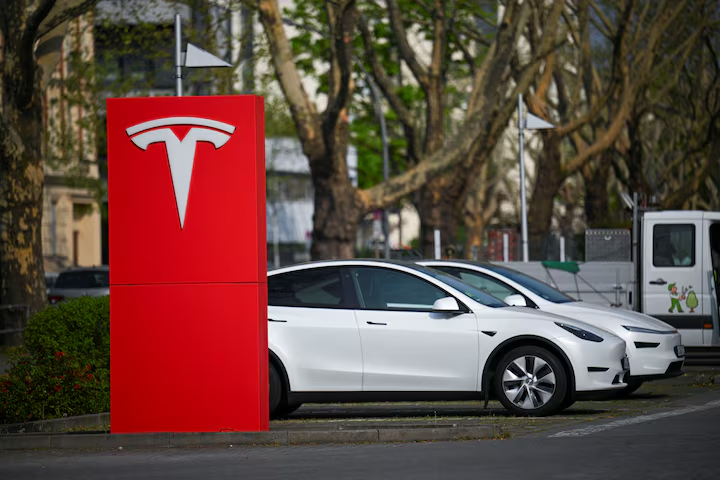

Over ninety percent of new passenger vehicles sold in Europe now come equipped with advanced driver assistance features. European roads have seen a massive rise in electric vehicle sales over the past five years. Tesla has spent years attempting to bring its most advanced software package to drivers across the continent. Regulators in European nations have pushed back against the name Full Self Driving because the software still requires total human attention. To clear these legal hurdles, Tesla has officially updated the product name to Assisted Driving across European markets.
This strategic name change represents a major shift in how the electric vehicle maker presents its technology. For years, consumer advocacy groups and government transport ministries argued that the original name was misleading. Drivers sometimes assumed the vehicle could operate completely on its own without human intervention. Rebranding the software helps the automaker comply with European consumer protection laws while working toward formal regulatory approval.
Why European Regulators Demanded a New Name
European transport authorities follow very strict rules when it comes to automotive advertising and vehicle safety. The United Nations Economic Commission for Europe sets international guidelines for vehicle systems that many countries follow. Regulators raised concerns that calling a system Full Self Driving could lead to dangerous driver complacency. If a driver believes a car is fully autonomous, they might stop paying attention to the road ahead.
German courts previously ruled against Tesla in advertising disputes regarding driver assist terminology. Judges noted that marketing materials gave the false impression that the cars were ready for autonomous operation without human control. By adopting the name Assisted Driving, the company aligns its marketing with the legal reality of its current software. The updated label makes it clear that the person in the driver seat remains legally responsible at all times.
Honest labeling is a core legal requirement across all European consumer markets. Regulators want to ensure that drivers do not confuse driver support tools with robotic chauffeurs. The name Assisted Driving sets accurate expectations before a customer even steps inside the vehicle. This clarity reduces the risk of misuse and protects both drivers and pedestrians on public roads.
Supervised Driver Assistance Versus True Autonomy
Automotive engineers classify automated driving systems into six distinct levels ranging from zero to five. A Level zero system provides basic warnings, while a Level five system drives everywhere in all weather conditions without human pedals or steering wheels. The current software package offered by Tesla operates as a Level 2 driver support system. Level 2 systems can control steering, acceleration, and braking simultaneously, but they require continuous human supervision.
True autonomous driving begins at Level 3, where the vehicle computer takes legal responsibility under specific traffic conditions. Level 4 systems can operate without human intervention inside designated city zones, like driverless taxi fleets in major cities. Because the European software requires drivers to keep their hands on the wheel and eyes on the road, it fits squarely into the Level 2 category. Renaming the software to Assisted Driving accurately reflects its true technical classification.
Drivers must remain alert and ready to take over control at any second during a trip. The computer does not replace human judgment, especially in bad weather or unusual road construction zones. Calling the system an assistant reminds operators that they are still the primary driver. This technical distinction is vital for meeting international automotive safety standards.
Inside the European DCAS Regulatory Framework
Approval for advanced driver support software in Europe depends on a regulatory framework known as Driver Control Assistance Systems. This legal framework was developed by transport safety committees to govern how modern cars assist human drivers. The guidelines allow cars to change lanes, follow road curves, and adjust speed based on traffic signs. However, the rules place strict boundaries on how aggressively the software can turn the wheel or initiate lane movements.
European rules require systems to confirm driver readiness before making automated maneuvers on public highways. For example, when a car prepares to change lanes, the system must verify that the driver is actively watching side mirrors and road traffic. The software cannot make sudden lane shifts without giving surrounding drivers clear visual warning signals. Meeting these detailed technical standards requires extensive software modifications before European agencies grant full type approval.
Automakers must submit extensive validation data and safety test results to government inspectors. Regulators evaluate how the software handles sensor blockages, sudden road hazards, and unexpected driver disengagements. Tesla engineers have worked closely with European safety authorities to ensure the software code follows every line of the DCAS guidelines. This collaborative testing process is essential for securing commercial permits across the continent.
Comparing Tesla Driver Assist Tiers in Europe
| System Tier | Official European Name | Core Capabilities | Human Responsibility |
|---|---|---|---|
| Base Package | Autopilot | Traffic aware cruise control and lane centering | Continuous steering control and attention |
| Mid Tier | Enhanced Autopilot | Automated lane changes, highway guidance, auto parking | Active supervision and prompt intervention |
| Top Tier | Assisted Driving | City street steering, traffic light and stop sign response | Total legal responsibility with hands on wheel |
How In Cabin Cameras Enforce Driver Attention
Driver monitoring has become a mandatory safety requirement for modern vehicles sold throughout the European Union. New safety regulations require cars to detect driver distraction, drowsiness, and eye gaze direction in real time. Tesla vehicles utilize an in cabin optical camera mounted above the rearview mirror to monitor driver attentiveness. The camera tracks head position and eye movements to ensure the driver remains focused on the road ahead.
If the internal camera detects that a driver is looking down at a mobile phone, the system triggers visual alerts on the main screen. Continuing to ignore these warnings results in loud audio chime alerts and flashing visual cues. If a driver repeatedly ignores the safety warnings, the software will disable driver assist features for the remainder of the drive. These strict software lockouts prevent drivers from abusing driver assist capabilities on public roadways.
Steering wheel sensors work alongside the cabin camera to provide dual layer safety verification. The steering wheel measures subtle rotational resistance from the driver hands to confirm physical engagement. If the wheel does not detect physical contact for several seconds, the system prompts the driver to apply gentle turning force. Combining optical gaze tracking with physical wheel sensors satisfies the strict safety criteria set by European transport regulators.
Adapting Vision Software for European Road Layouts
European road networks present unique driving challenges that differ significantly from North American highways. European cities feature narrow historic streets, complex multi lane roundabouts, and dense networks of bicycle lanes. Pedestrian crossings are frequent, and speed limits change rapidly between rural zones and urban centers. The software must process these complex road layouts with absolute reliability to operate safely.
Engineers have spent months adapting neural networks to recognize diverse European road signage and pavement markings. Speed limit signs in Europe vary by country, with specific rectangular shapes and circular borders that require accurate camera recognition. The software must also recognize temporary construction signs, electronic variable speed displays, and priority intersection markers. Training the vision models on millions of miles of European driving data ensures smooth software performance across different countries.
Roundabouts represent one of the most critical driving scenarios that European regulators evaluate. In many European nations, roundabouts replace standard four way traffic light intersections. The software must calculate vehicle entry gaps, yield to circulating traffic, and signal properly when exiting the roundabout. Mastering European traffic circles is essential for winning official safety clearance from national transport agencies.
Comparing Tesla with European Luxury Competitors
Traditional European automakers are also investing billions of dollars into advanced driver assistance technology. Mercedes Benz achieved a major regulatory milestone by winning official Level 3 approval for its Drive Pilot system in Germany. Drive Pilot allows drivers to legally take their eyes off the road during heavy highway traffic jams at speeds up to sixty kilometers per hour. During active Level 3 operation, Mercedes assumes legal liability for the vehicle actions.
BMW offers its own advanced highway assistant that permits hands free driving at higher speeds on divided motorways. These European competitors rely on a rich sensor suite that combines optical cameras, radar units, and laser scanners. Laser sensors bounce light beams off surrounding objects to create precise three dimensional spatial maps in dark or foggy weather. European safety regulators have historically favored multi sensor designs that provide physical hardware redundancy.
Tesla takes a fundamentally different engineering path by relying exclusively on optical cameras, a strategy known as Tesla Vision. The company removed radar and ultrasonic sensors from its vehicles, arguing that artificial neural networks can interpret visual data just like human eyes. Demonstrating that a camera only system matches the safety performance of laser equipped vehicles has been a core challenge in European regulatory hearings. Winning approval with vision only software would validate the company unique engineering philosophy.
Key Benefits of the Rebranding for European Drivers
- Clear and honest marketing that eliminates confusion about autonomous vehicle capabilities.
- Faster path to regulatory approval under United Nations Economic Commission for Europe guidelines.
- Standardized feature rollouts that comply fully with local member state traffic laws.
- Enhanced driver monitoring protocols that reduce accident risks caused by distracted driving.
- Seamless over the air software delivery to existing vehicles once official permits are granted.
Hardware Requirements: Hardware 3 Versus Hardware 4
The computational power required to run advanced vision neural networks demands specialized onboard computer hardware. Older Tesla vehicles built between twenty nineteen and twenty twenty three utilize the Hardware 3 computer platform. Newer production models feature Hardware 4, which includes faster processors, higher resolution cameras, and expanded memory bandwidth. The upgraded cameras provide clearer images at greater distances, helping the computer spot small road hazards earlier.
European drivers who purchased the advanced software package on older vehicles want reassurance that their cars will support future updates. The company has stated that both hardware generations will receive software improvements as European approvals progress. However, Hardware 4 vehicles process visual data with greater fidelity, allowing neural networks to run at higher frame rates. Ensuring consistent performance across different hardware revisions remains an active engineering priority.
Power consumption is another important factor when running complex vision models on electric vehicles. Processing billions of video operations every second generates heat and draws electrical power from the main battery pack. Efficient silicon design ensures that running the driving software does not reduce vehicle driving range significantly. Balanced energy consumption allows drivers to enjoy assistive features without sacrificing battery efficiency on long trips.
Consumer Protection and Legal Accountability
Consumer protection agencies across Europe have welcomed the updated naming convention. Clear terminology prevents buyers from spending thousands of euros on software under false expectations. When consumers comprehend that the system assists rather than replaces the driver, they use the technology with appropriate caution. Honest labeling builds long term consumer trust in emerging automotive technology.
Insurance providers also monitor driver assist terminology and accident data closely. When drivers misunderstand software capabilities, insurance claim rates rise due to avoidable collisions. Clear categorization as an assistive tool helps insurance underwriters set accurate risk profiles and policy rates for electric vehicles. Proper risk assessment keeps insurance premiums fair for responsible drivers who use the features correctly.
Legal liability during accidents remains squarely with the human operator under current European transport statutes. If a vehicle violates a traffic rule or causes a collision while using assistive software, the person in the driver seat receives the traffic citation. Renaming the software removes any ambiguity in court cases regarding driver responsibility. Drivers cannot claim they believed the car was operating as an autonomous robot.
Over the Air Updates and Gradual Feature Releases
One of the greatest advantages of modern software defined vehicles is the ability to improve through over the air updates. Once European regulators grant formal approval for specific driving functions, Tesla can activate those features wirelessly overnight. Drivers wake up to find new capabilities installed in their cars without visiting a service center or dealership. This digital delivery model allows the automaker to roll out features gradually as legal permissions expand.
Initial releases will focus on highway driving assistance, automated parking maneuvers, and basic intersection crossing. As the software proves its reliability across millions of fleet miles, regulators may approve more complex urban driving maneuvers. This phased rollout allows safety agencies to review real world incident data before expanding operational domains. Gradual deployment protects public safety while letting drivers enjoy modern convenience features.
Drivers can also provide direct feedback through in car reporting tools to help developers improve software performance. If the car makes an unexpected maneuver or hesitates at a complex intersection, the driver can submit a quick diagnostic report. Engineering teams analyze these unusual situations to refine neural network weights in future software builds. Continuous learning from real world driving data makes the software smarter with every update.
The Global Picture: Differing Approaches in the US, China, and Europe
The global landscape for autonomous vehicle regulation is split into three distinct regional models. The United States uses a flexible regulatory model that allows automakers to deploy beta software to public customers with minimal federal pre approvals. This open environment allows companies to collect vast amounts of driving data quickly, but it has drawn criticism from road safety advocates following high profile accidents.
China has established dedicated pilot zones in major cities like Beijing, Shanghai, and Shenzhen to test autonomous driving. Chinese municipal authorities work closely with technology companies to create smart road infrastructure with digital traffic beacons. Tesla recently secured initial data compliance approvals in China, paving the way for testing advanced software in the world largest electric vehicle market. Government cooperation has accelerated autonomous development across Chinese metropolitan areas.
Europe maintains the most cautious regulatory stance, prioritizing preventative safety standards and strict pre market certification. European agencies demand rigorous testing documentation and formal safety proofs before software touches public roads. While this thorough review process slows down feature rollouts, it ensures that approved systems meet the highest global safety benchmarks. Tesla willingness to rename its product proves that adapting to European regulatory standards is essential for global business success.
What European Tesla Owners Should Expect Next
European owners who already paid for the top tier software package can expect a steady progression of feature activations. The software will guide vehicles through city streets, manage lane position in complex traffic, and stop for traffic signals under direct driver supervision. Drivers will need to maintain continuous focus and be ready to take over steering or braking instantly. The software is designed to reduce driving stress on long commutes, not to let drivers sleep or read books.
Public road testing with European safety authorities will continue throughout upcoming regulatory sessions. Transportation committees will evaluate real world safety metrics, driver monitoring reliability, and system disengagement rates. Positive evaluation results will lead to broader commercial permits across all European Union member states. The rebranding to Assisted Driving marks the beginning of an exciting new chapter for smart mobility in Europe.
Automated driving technology is moving away from exaggerated promises and toward practical, verified daily assistance. Drivers will benefit from smoother highway merging, stress free parallel parking, and reliable speed management in heavy traffic. As software updates roll out across Europe, drivers will experience how advanced vision systems enhance everyday road safety. The future of driving is collaborative, combining intelligent machine perception with alert human judgment.
Embrace the Future of Assisted Driving Today
Tesla decision to rename Full Self Driving to Assisted Driving in Europe represents a sensible and mature step toward regulatory compliance. Aligning product marketing with legal reality satisfies consumer protection authorities and paves the way for official software approval. The updated name sets honest expectations while delivering powerful Level 2 driver support features that make daily travel safer and more relaxing.
As automotive technology moves forward, clear communication between carmakers, regulators, and everyday drivers is vital. Knowing the true capabilities and limits of your vehicle software ensures that you enjoy modern driving features safely. If you drive an electric vehicle equipped with smart driving tools, stay informed on local traffic regulations and software updates in your country. Embrace the convenience of modern driver assistance while keeping your eyes on the road and hands on the wheel.



Discussion
No comments yet. Be the first to share your thoughts!
Leave a Comment