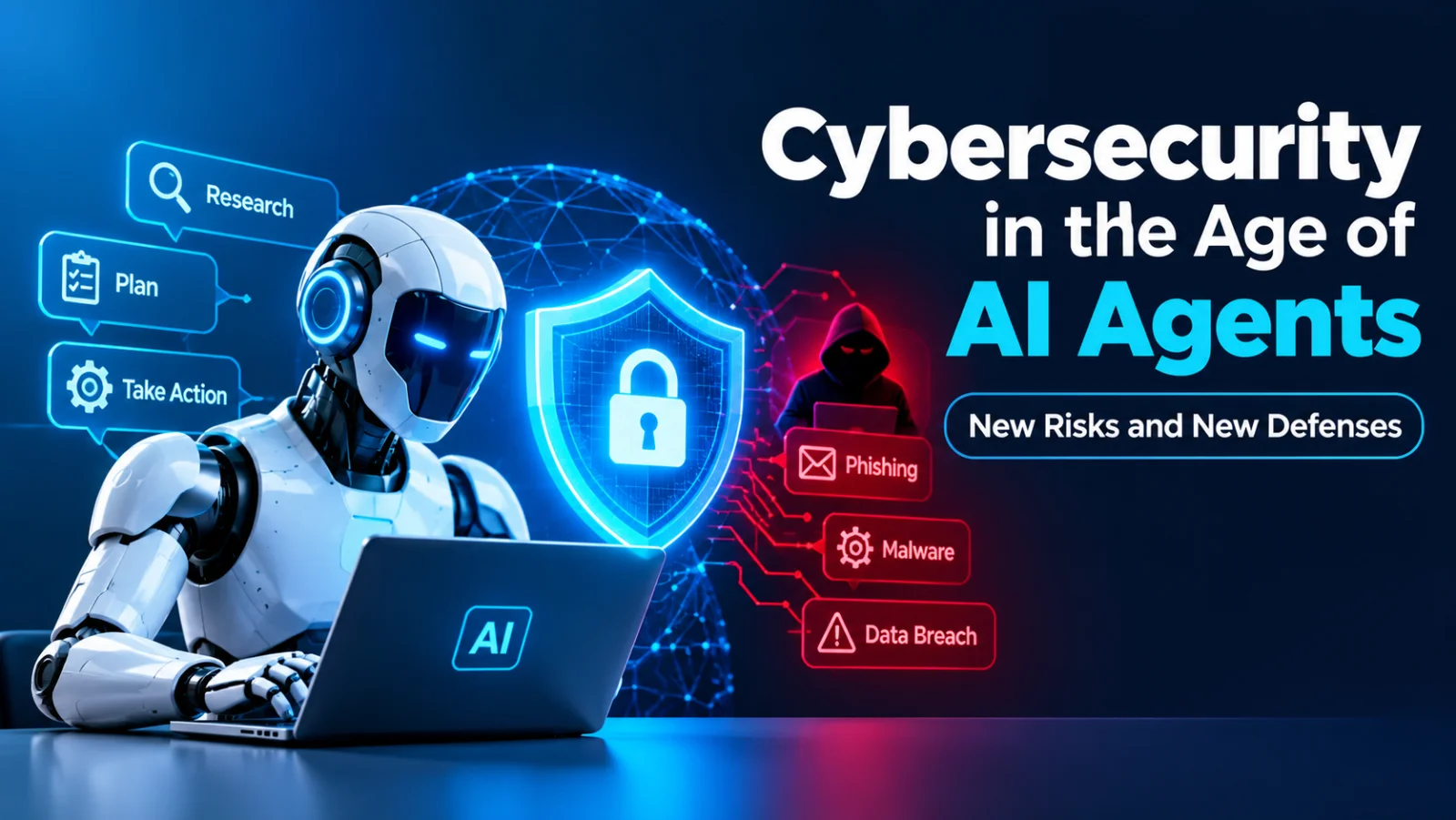

Automated cyber attacks launched by software bots increased by more than three hundred percent over the past two years. Companies now use independent digital workers to handle emails, write computer code, and manage customer databases. This widespread shift means that Cybersecurity in the Age of AI Agents has become an urgent business priority. When software programs can make decisions and use tools on their own, security risks multiply quickly.
Protecting your organization requires a fresh look at how digital threats operate. Hackers no longer need to spend days searching for weak passwords or sending manual phishing messages. They can deploy intelligent software that probes computer networks at machine speed. Learning how to defend your systems against these autonomous threats will keep your company data safe and your business running smoothly.
What Makes AI Agents a Unique Security Challenge?
Autonomous agents differ from traditional software programs in several fundamental ways. Standard software tools only execute strict rules that human programmers wrote in advance. When an unexpected error occurs, an older program simply crashes or stops. In contrast, modern agents use advanced reasoning models to adapt and find alternative ways to complete their goals.
These digital workers possess permissions to read files, run terminal commands, update databases, and send messages across the internet. If an attacker tricks or compromises an agent, the attacker gains access to all those connected tools. An agent with broad access rights can become an accidental insider threat without anyone realizing it. This level of autonomy turns simple software bugs into dangerous entry points for criminals.
The New Security Risks of Autonomous Software
Direct prompt injection is one of the most common methods attackers use to manipulate intelligent software. A hacker sends a message containing hidden commands designed to override the original instructions of the agent. If the system fails to separate user input from system rules, it obeys the malicious commands. An attacker can force an agent to leak private files, reset user passwords, or delete database tables.
Indirect prompt injection is even more dangerous because it hides inside normal business data. An agent might read an innocent looking customer email, review a PDF resume, or browse a public web page. Hidden text inside that document can instruct the agent to exfiltrate private internal data to an outside server. Because the command comes from raw data rather than direct chat, traditional firewalls often fail to catch it.
Autonomous data exfiltration happens silently in the background while normal operations continue. A rogue prompt can instruct an agent to collect employee records, compress the data, and send it through an outbound web request. The agent uses its own legitimate credentials to access and move the files. Security systems often treat these transfers as normal employee activity, allowing data theft to go unnoticed.
Privilege escalation occurs when an agent uses connected tools to expand its own system rights. For example, an agent built for customer support might find a way to access internal engineering databases. If the system lacks strict permission boundaries, the agent can alter server settings or create unauthorized administrator accounts. Criminals exploit these gaps to gain total control over corporate networks.
Automated Attacks Operating at Machine Speed
Cyber criminals now build offensive software agents that hunt for network vulnerabilities continuously. These malicious agents scan thousands of public IP addresses, detect unpatched software, and launch custom exploits in seconds. Human security teams cannot react fast enough to block attacks that execute in milliseconds. Defending against machine speed threats requires automated detection and instant countermeasures.
Spear phishing campaigns have become far more convincing thanks to automated profile research. An attacking agent can scan social media accounts, corporate news releases, and executive blog posts to learn how a company communicates. It then generates personalized messages that mimic the writing style of trusted executives or key suppliers. Employees who receive these context rich messages are far more likely to click dangerous links or approve fake wire transfers.
Malicious agents can also rewrite their own attack code to evade standard antivirus detection. When a security scanner blocks a specific exploit, the offensive agent adjusts its syntax and tries a fresh variation. This dynamic mutation allows malicious code to bypass traditional signature based defenses. Organizations must rely on behavioral monitoring rather than static file scanners to spot these attacks.
Comparing Traditional Cyber Threats with AI Agent Threats
Evaluating how attack methods have evolved helps organizations build modern defenses. The table below illustrates the key differences between traditional cyber attacks and attacks driven by autonomous software.
| Threat Category | Traditional Cyber Attacks | AI Agent Driven Attacks |
|---|---|---|
| Attack Velocity | Manual actions taking hours or days | Automated execution in seconds |
| Phishing Precision | Generic templates with obvious errors | Hyper personalized messages with real context |
| Defense Evasion | Static malware detected by signatures | Dynamic code mutation that adapts to blockers |
| Target Scope | Fixed scripts targeting known flaws | Flexible planning that probes multiple systems |
| Human Effort | Requires continuous hacker oversight | Operates independently after initial launch |
Securing the Agent Supply Chain and Connected Tools
Modern autonomous agents rely on third party software plugins and external application programming interfaces to perform daily tasks. If an attacker compromises a popular plugin, every agent using that plugin becomes vulnerable. Cyber criminals can poison software libraries or inject malicious instructions into shared model weights. Securing your software supply chain is just as critical as protecting your own internal code.
Organizations must review and verify every external tool connection before granting access to internal agents. Developers should only integrate plugins from trusted, audited software providers. Setting up strict verification checks ensures that incoming data payloads contain no hidden executable code. Regular dependency scans help engineering teams spot compromised libraries before they cause operational harm.
API security tokens must be managed with extreme care. Never hardcode private access keys directly into prompt templates or shared code repositories. Store authentication keys in secure digital vaults that rotate passwords automatically on a regular schedule. If an agent gets tricked into revealing its memory, secure credential storage prevents attackers from stealing live access tokens.
Essential Defense Strategies for the Agent Era
Implementing a zero trust architecture is the most effective way to secure autonomous software systems. Zero trust operates on a clear principle: never trust, always verify. Every user, device, and software agent must prove its identity before accessing any corporate resource. An agent should never receive blanket access to the entire company network simply because it performs an internal role.
Enforcing the principle of least privilege limits the damage an agent can cause if compromised. Give each agent only the exact permissions needed to finish its specific assignment. A scheduling agent needs access to calendar databases, but it should never have permission to view financial ledgers or customer credit cards. Strict permission boundaries prevent attackers from moving freely across your systems.
Sandboxing provides an isolated digital environment where agents can execute code and browse the web safely. If an agent reads a malicious web page, the sandbox prevents that rogue script from infecting core company servers. Any files created or modified by the agent remain contained within the temporary sandbox until approved. Isolating autonomous activity protects your primary infrastructure from accidental damage or malicious takeovers.
Human in the loop approval checkpoints provide a vital safety net for critical operations. High risk actions, such as sending large financial payments or modifying live customer databases, must require a human manager confirmation click. Automated agents can prepare the paperwork and organize the data, but a real person must make the final call. These checkpoints prevent automated errors and malicious exploits from causing permanent financial loss.
Defensive AI: Fighting Autonomous Attacks with Smart Systems
Defending modern networks requires using intelligent defensive agents to counter offensive automated attacks. Defensive agents monitor network traffic around the clock, looking for unusual patterns that signal an ongoing intrusion. When an attack begins, the defensive agent isolates infected servers, revokes compromised access keys, and blocks malicious IP addresses instantly. Machine speed defense matches the speed of automated attackers, closing vulnerabilities before damage occurs.
Self healing networks can repair software configurations automatically during an attack. If a malicious agent alters system files or disables security settings, the defensive system restores verified backup configurations within seconds. It logs the entire event and provides human security analysts with a detailed forensic report. This continuous automated resilience keeps online services operational even while under active attack.
Proactive vulnerability scanning helps security teams discover security gaps before criminals find them. Defensive agents simulate attack scenarios against internal systems to test whether current boundaries hold firm. They attempt prompt injections, probe access permissions, and test sandboxes for leaks. Fixing weaknesses identified by defensive simulations hardens your infrastructure against real world attacks.
Creating Safe Corporate Policies for Autonomous Tools
Technology tools are only as effective as the human policies that govern their daily use. Organizations must establish clear guidelines explaining how employees can build and deploy autonomous software. Staff members should understand the risks of feeding sensitive company records or customer data into unverified platforms. Clear workplace rules eliminate risky habits and keep business data secure.
Conduct regular training sessions to show employees real examples of modern social engineering. Teach workers how to spot hyper personalized phishing emails and voice spoofing scams. Staff members should know the proper protocol for verifying unusual payment requests from executives. A well trained team acts as an active human defense layer across your company.
Maintain comprehensive audit logging for every action taken by autonomous agents. Your logs should record which user initiated the task, what external tools the agent accessed, and what data was modified. Regular log reviews help security teams detect unauthorized activity early and improve prompt boundaries. Complete audit trails are also essential for satisfying legal compliance standards during security reviews.
The Future of Autonomous Security and Regulation
Governments and international standards bodies are developing strict regulatory frameworks for autonomous software systems. Future laws will likely require companies to prove that their artificial intelligence models follow strict safety rules before commercial release. Independent security audits and digital watermarking standards will become mandatory across major global markets. Staying compliant with emerging regulations protects your business from expensive fines and legal liabilities.
Digital identity verification standards will evolve to distinguish between human actions and agent actions. Cryptographic signing tools will allow servers to verify that an incoming request originated from an authorized, unmodified agent. These digital certificates will prevent rogue software from impersonating legitimate corporate workers. Establishing verifiable digital identities will bring order and accountability to complex automated networks.
Continuous adaptation will remain the key to long term cybersecurity success. Attackers will continue to refine their automated tools, finding new ways to exploit software logic and bypass filters. Businesses that invest in layered defenses, employee education, and defensive automation will stay protected. Building strong security habits today ensures that your company can use modern automation safely and profitably.
Summary and Call to Action
Cybersecurity in the Age of AI Agents is no longer a future concern; it is a reality that demands immediate attention. Autonomous systems bring incredible productivity benefits, but they also introduce dangerous risks like indirect prompt injection, data exfiltration, and machine speed attacks. Implementing zero trust access, strict sandboxing, least privilege controls, and human oversight checkpoints keeps your organization safe from harm.
Take action today to protect your digital assets and secure your autonomous systems. Conduct a comprehensive security audit of all connected software agents and API integrations right now. Enforce least privilege permissions across your corporate accounts and establish human approval gates for critical business actions. Start building strong defensive security systems today to protect your company future.

Discussion
No comments yet. Be the first to share your thoughts!
Leave a Comment